Curated by Nadia Stefanel
The Arts House, Singapore
1-7 October 2025
More details:
https://quantum2025.org/iyq-event/quantum-perspective-the-art-of-interference/
https://fondazionedinozoli.com/en/quantum-perspective-the-art-of-interference/
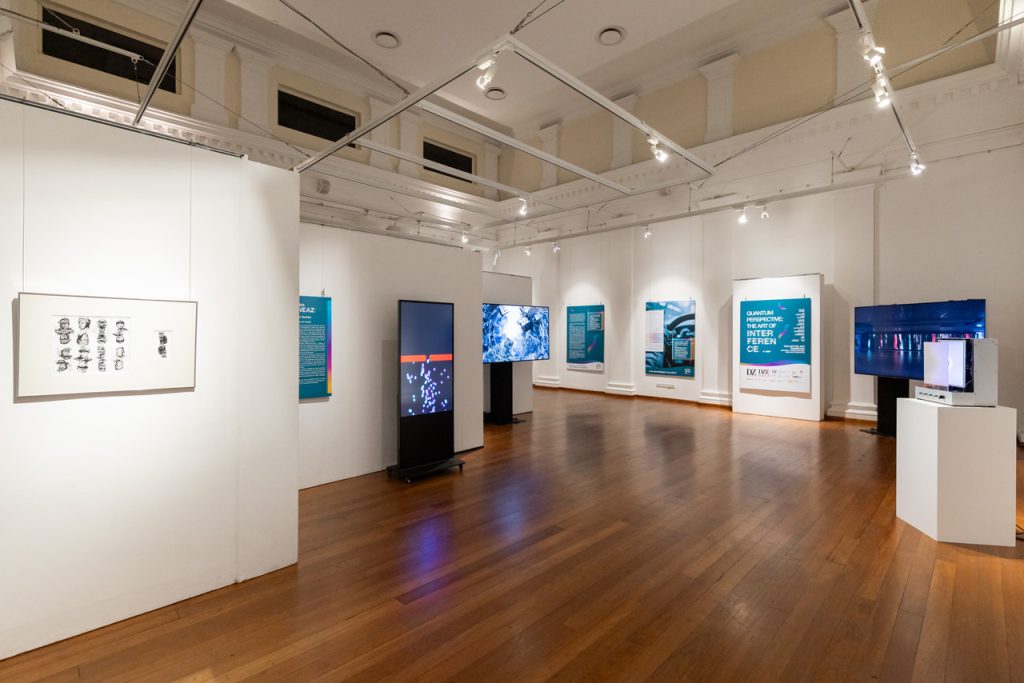
In celebration of the International Year of Quantum Science and Technology (IYQ), initiated by the United Nations to commemorate a century of quantum mechanics, the Dino Zoli Foundation and DZEAsia are hosting this art exhibition in Singapore during the Formula 1 Grand Prix. This initiative unites Italian and Singaporean artists to delve into the fusion of quantum science and artistic expression.
https://quantum2025.org/iyq-event/quantum-perspective-the-art-of-interference/
The Singapore Grand Prix is more than a motorsport event: it’s a celebration of precision, speed, and the cutting edge of human ingenuity. Formula 1 engineers work at microscopic tolerances, where the smallest adjustment can mean the difference between victory and defeat. Quantum science inhabits a similar domain of extremes, but on a much smaller scale: the realm of atoms, electrons, and photons, where behaviour follows rules that seem to defy everyday logic.
In this invisible world, particles act as waves, existing in multiple states at once, entangled across vast distances, and tunnelling through barriers that appear impenetrable. These counterintuitive behaviours are not fantasy but experimentally verified features of nature, forming the basis of an ongoing technological revolution. Quantum computers work through countless possibilities simultaneously; quantum sensors measure with exquisite sensitivity; quantum materials promise unprecedented strength or conductivity. In Formula 1, such advances could optimise race strategies, design aerodynamic components at the molecular scale, or synchronise timing systems to billionths of a second.
Singapore’s Night Race weekend becomes the perfect backdrop: a city of lights hosting the fastest machines on Earth, set against art that engages with the most extraordinary rules in the universe.
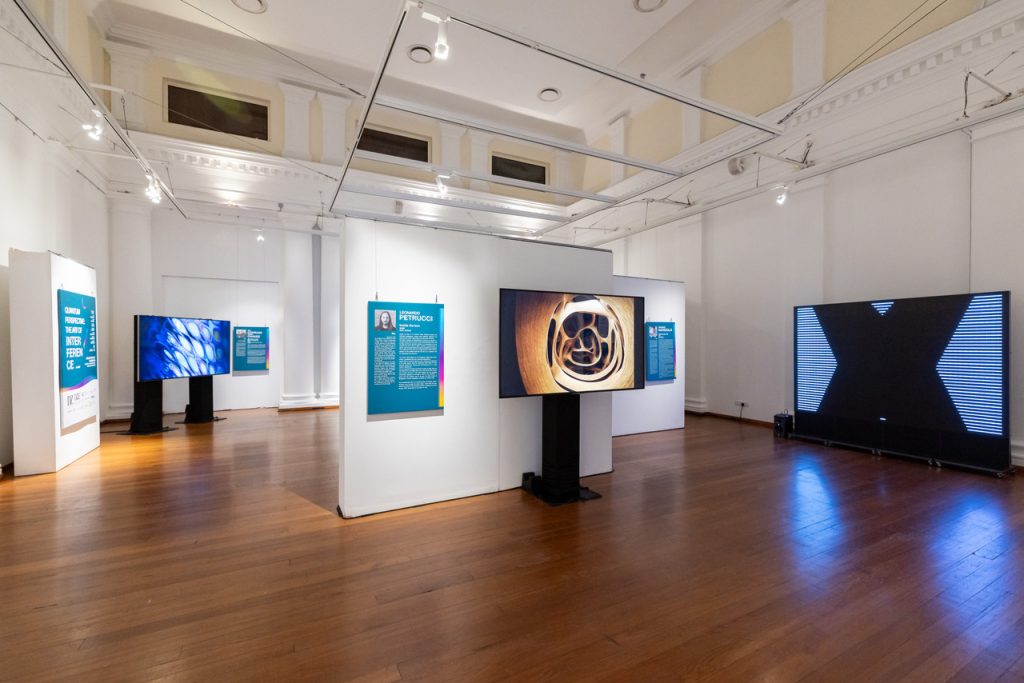
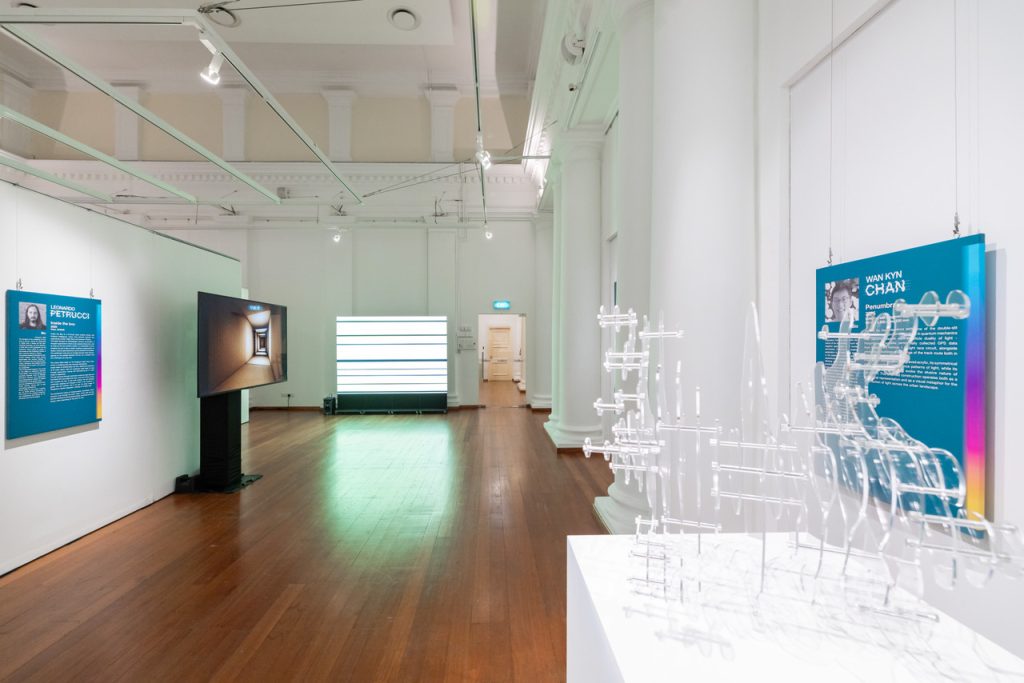
Quantum mechanics describes a world apparently far from everyday perception: particles that are also waves, systems that exist in many states at once. Yet, paradoxically, quantum theory shapes the most tangible parts of our world, from the silicon chips in our phones to the LEDs that light up Singapore’s night. How can such phenomena be represented visually? Each artist in this exhibition responds in her/his own language.
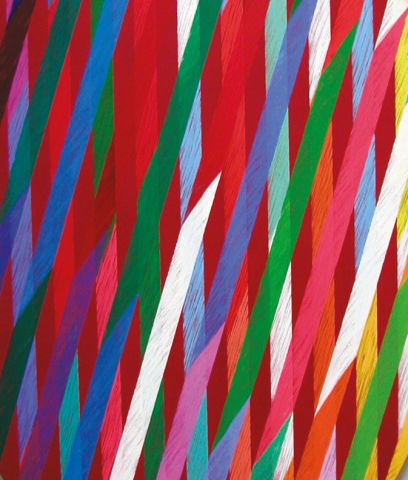
This exhibition is about translation: turning the abstract mathematics of quanta into visual and emotional experiences. Giuliana Cuneaz’s Quantum Quirks plays with shifting forms that echo the fluidity of probabilities, making uncertainty something we can watch unfold. Vincenzo Marsiglia’s Stroboscopic Star pulses with rhythmic geometries, recalling both racing telemetry and the oscillations of quantum states. Giacomo Costa’s Circuit n.1 merges engineered and natural landscapes, recalling both racetracks and particle detectors. Leonardo Petrucci’s Inside the Box invokes curiosity and paradox. Jake Tan’s 1 Qubit installation gives tangible form to quantum information. Elena Lo Giudice’s work invites viewers to reflect on the indeterminate nature of outcomes, where meaning is suspended, until a moment of resolution collapses the possibilities into one, while Wan Kyn Chan, Ina Conradi, and Mark Chavez expand the dialogue with light, precision, and immersive projection. Together, these artists help us feel what we cannot directly see. They bridge science and imagination, turning the most abstract rules of the universe into stories that resonate with our senses, just as Formula 1 translates physics into speed and spectacle.
Quantum art is not about illustrating equations; it is about evoking the feelings those equations provoke: wonder, disorientation, curiosity. Against the backdrop of the Singapore Grand Prix, these works remind us that speed and spectacle can be matched by stillness and subtlety, and that the rules that govern electrons are as beautiful and surprising as those that govern engines.