Art, Fluid Dynamics and Transformation in Dialogue in Singapore
Curated by Nadia Stefanel
Preview: 22–31 January 2026, ANGRA
Group Exhibition: 7–14 October 2026, The Arts House, Singapore
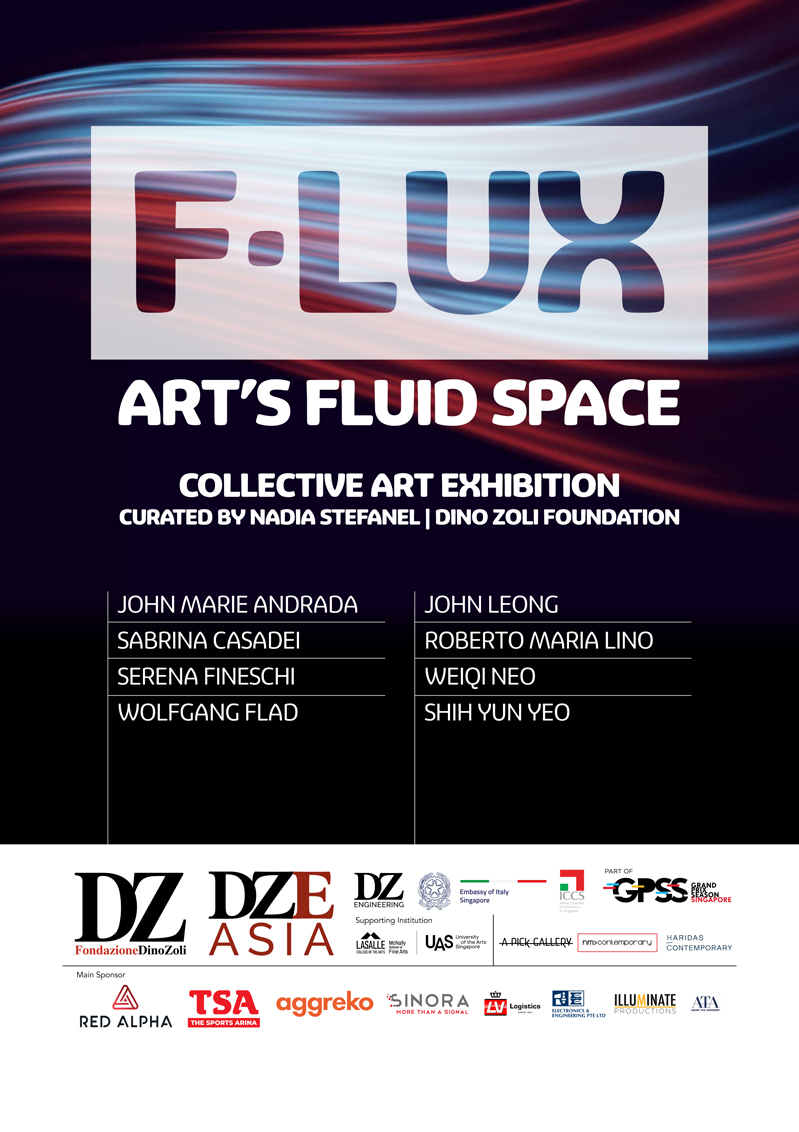
Artists: John Marie Andrada, Sabrina Casadei, Wolfgang Flad, Serena Fineschi, John Leong, Roberto Maria Lino, Weiqi Neo, Shih Yun Yeo
From 7 to 14 October 2026, The Arts House in Singapore hosts F-LUX. Art’s Fluid Space, a group exhibition curated by Nadia Stefanel exploring the dialogue between art and fluid dynamics, at the point where the rigour of scientific research meets the energy of artistic imagination.
Preceded by a preview held at ANGRA from 22 to 31 January 2026, the project brings together Italian and international artists in an exhibition that investigates movement, transformation, energy and unpredictability, interpreting flow not merely as a physical phenomenon, but as a principle through which to understand contemporary reality.
At the heart of the exhibition lies the ancient Heraclitean concept of Panta Rhei — “everything flows”. In the philosophy of Heraclitus of Ephesus, reality is shaped by a continuous and unstoppable process of becoming: nothing remains permanently identical to itself, as everything exists through transformation and the tension between different states.
In F-LUX, this philosophical vision encounters fluid dynamics and becomes a visual experience.
Movement, energy and transformation provide common ground between science and art: matter appears to come alive, while form is no longer perceived as something stable and definitive, but rather as the temporary outcome of forces interacting with one another.
Art as a Field of Forces
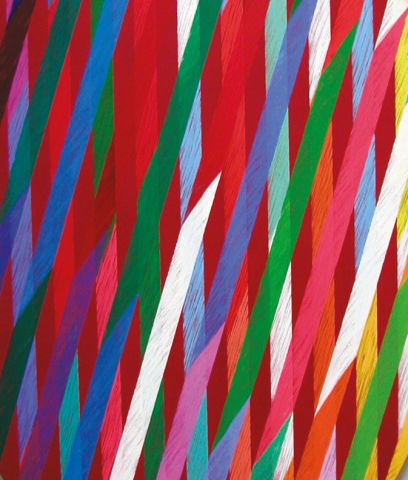
Lines, vortices, layers, expansions and vibrations make energy visible. Colour loses its purely descriptive function and becomes a process in itself: it flows, expands, concentrates and responds to the conditions surrounding it.
The surface of the artwork is thus transformed into a true field of forces, where intention and matter, gesture and physical response, continuously interact.
Concepts drawn from fluid dynamics — such as viscosity, turbulence, friction and pressure — therefore become tools through which the artistic process itself may be observed. The artwork is no longer understood as a closed and immutable object, but as a dynamic system: a threshold between the visible and the invisible, permanence and dissolution.
The history of art offers numerous precedents for this fascination with movement. From the currents and vortices that animate the sky in Vincent van Gogh’s The Starry Night, to the speed and lines of force explored by Futurists such as Umberto Boccioni and Giacomo Balla, and on to Jackson Pollock’s dripping technique, in which gesture, gravity, viscosity and the trajectory of paint become inseparable from the very process of creation.
In contemporary practices, from Fluid Art to digital and algorithmic experimentation, the principle of flow takes on new forms while reaffirming the same underlying vision: creation as an open-ended process, suspended between order and chaos, control and freedom.
From Fluid Dynamics to Formula 1
The relationship with motorsport, and Formula 1 in particular, introduces a further dimension to the project.
The aerodynamics of a Formula 1 car represent an extraordinary synthesis of scientific research, engineering design and the pursuit of performance. Controlling airflow and vortices is crucial: every component of the car is designed to maximise aerodynamic downforce while reducing drag.
Yet what is being studied and controlled is never truly static. The air surrounding the car changes constantly according to speed, vehicle set-up and environmental conditions. Engineering therefore does not operate on fixed forms, but on dynamic systems in a continuous state of transformation.
From this perspective, Heraclitus’ famous river finds a compelling contemporary parallel: just as it is impossible to step into the same river twice, no driver ever passes through exactly the same airflow twice.
Art and Science during the Singapore Grand Prix
The project forms part of the cultural programme developed over the years by the Dino Zoli Foundation, together with DZeAsia and DZ Engineering, a Zoli Group company involved in the development of lighting and telecommunications systems for the Marina Bay circuit.
On the occasion of the Formula 1 Singapore Grand Prix, this collaboration has given rise to a series of projects exploring the encounter between art, science and technology, addressing subjects ranging from light and emerging technologies to artificial intelligence and quantum science.
Following projects dedicated to quantum science in 2025, Artificial Intelligence in 2024, and light in 2023, in 2026 F-LUX turns its attention to fluid dynamics, once again bringing scientific research into dialogue with artistic imagination.
The selected works translate the complexity of natural forces into a visual universe composed of currents, vibrations, layers and continuous metamorphoses. Through painting, installation and digital practices, the artists develop a visual language capable of evoking phenomena that, by their very nature, can never be permanently fixed.
The exhibition unfolds around three interconnected elements: water, air and time.
Water evokes metamorphosis and memory; air introduces the dimensions of invisibility, propagation and movement; time permeates every transformation, establishing a connection between physical phenomena and inner experience.
F-LUX. Art’s Fluid Space thus becomes a space in which art and science share the same fundamental question: how can we make perceptible a reality that never ceases to change?
An exhibition about movement, but above all about becoming. About the fragile balance between form and transformation. About the continuous flow that moves through matter, energy and time — and, inevitably, through our own experience of the world.
Exhibition Information
Exhibition Run: 8 to 13 October 2026
Opening Hours: 10am to 8pm
Location: The Arts House, 1 Old Parliament Lane, Singapore 179429
Admission: Free